

A Wellness Wednesday Conversation on The Debbie Nigro Show
Sometimes you meet somebody by chance and realize they have something important to share with the world.
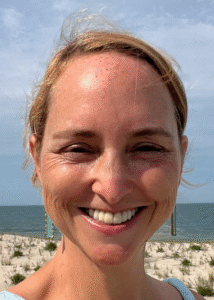
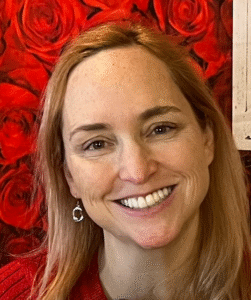
That’s what happened when I met Dr. Katie Prince Ferreira, affectionately known as Dr. Katie, through my daughter at the gym.
I liked her immediately. Then I learned about her incredible background in special education, her two young autistic children, and the wonderful books she’s creating to help kids understand themselves.
I knew I wanted her on my show!
Dr. Katie has spent more than 20 years in education and holds a doctorate in special education with a focus on autism and intellectual disabilities.
But even with all that professional knowledge, becoming the mother of two autistic children gave her a whole new perspective.
Our conversation was fascinating, heartwarming, and incredibly educational.
And I asked her some questions I think a lot of parents and grandparents probably have.

How Did You Know Your Children Had Autism?
Dr. Katie’s response? “That’s an excellent question.”
She explained that her daughter initially seemed like any other baby. But as she grew, Katie noticed she wasn’t speaking, didn’t always make eye contact, and had sensitivities to certain clothing and textures.
Katie began teaching her sign language and eventually sought speech therapy and other support services.
Today, her daughter is four and talks a mile a minute!
Which led me to my next question.
Now That She’s Talking, What Are Her Challenges?
“That’s a great question,” Katie said.
She explained that social communication and sensory regulation are still important challenges.
Her daughter loves other children and wants friends but doesn’t automatically understand some of the unwritten social rules that other kids seem to pick up naturally.
How do you join a group? Tell someone they’re too close? Leave a game when you don’t want to play anymore?
These are skills Katie helps her children learn.
Meet Zippy! The Little Character Born From a Big Feeling
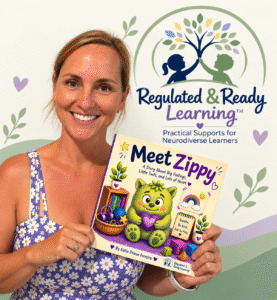
One of my favorite parts of our conversation was hearing how Zippy came to life.
In Katie’s house, being “Zippy” means having so much energy that your body just can’t seem to stop moving.
One day, while reading a book about emotions, her daughter announced, “Mommy, Zippy’s not in the book.”
So they drew a little green fuzzy character, taped him into the book, and Zippy was born!
That little character inspired a growing collection of children’s books and educational resources called Regulated and Ready Learning.
I love that!
How Do You Tell the Difference Between Autism and ADHD?
Another question I had, especially when children seem to have endless energy.
Katie’s response? “Good question.”
She explained that autism and ADHD can occur together, and that sensory regulation is about helping a child feel comfortable and calm in their own body.
Sometimes movement is exactly what a child needs.
Pushing a laundry basket, climbing, jumping, or other physical activities can help some children regulate their bodies so they’re better able to communicate, concentrate, and learn.
And every child is different.

Do Children Eventually Learn to Blend In?
This was another question I really wanted answered.
As children grow, can they learn to manage their challenges well enough to blend in with everybody else?
Katie said, “It’s a great question.”
And then she gave an answer I absolutely loved.
“The goal isn’t necessarily to blend in and fit in. The goal is to feel comfortable in your own skin and to become the best version of yourself that you can.”
WOW.
That really stayed with me.
I’m not much of a blender-inner myself, so I get that. LOL.
Katie explained that the goal is to help children recognize what they’re feeling, understand what they need, and feel confident asking for it.
Maybe it’s headphones when a room gets too noisy. Maybe it’s saying, “I need space.” Maybe it’s asking a trusted adult for help.
The point is to help children feel understood, capable, and proud of who they are.

Books That Help Children Feel Seen
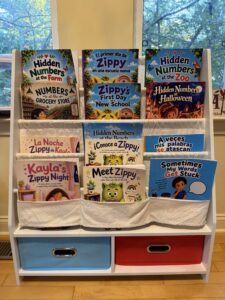
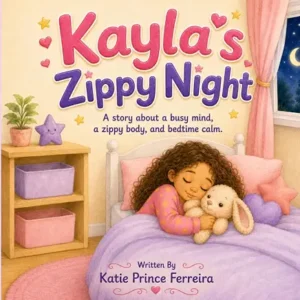
Dr. Katie has created 13 books, including her Zippy series, with many available in both English and Spanish.
They’re designed for parents, grandparents, teachers, and therapists to read with children.
She also creates practical educational materials to help with everything from making friends to managing sensory challenges.
And she shared something else that touched me.
Some autistic children work so hard to hold themselves together during the school day that they come home emotionally exhausted. Katie has taken time away from teaching to be there when her own children need that safe place to decompress.
There’s a lot of love behind this work.
I told Katie I think every teacher of young children should know about her books.
Because sometimes the best ideas come from somebody recognizing a need and deciding to do something about it.
And that’s exactly what she’s doing.
And How Does Dr. Katie Relax?
With all this going on, I had to ask!
Her answer?
Dance parties with her kids and reading in her hammock.
Two very different sports, I told her.
I’m volunteering for the next dance party. LOL.
I hope you’ll take a few minutes to listen to our conversation. Whether you’re a parent, grandparent, educator, or simply someone who wants to better understand children who experience the world differently, I think you’ll learn something valuable.
And you’ll meet a very special woman doing some very special work.
LISTEN TO MY CONVERSATION WITH DR. KATIE
Explore Dr. Katie’s Books and Educational Resources:
For Families on Linktr.ee.com ‘Regulated and Ready Learning’
For Teachers: on TeachersPayTeachers.com – Special Education Resources
Because every child deserves to feel safe, understood, and loved exactly as they are.
Keep the ‘Live’ in Alive!
— Debbie Nigro
The Debbie Nigro Show | Wellness Wednesday | 11-12noon EST /WGCH NY/CT 1490 AM / Hit ‘Listen Live’ Online at WGCH.com
AUDIO TRANSCRIPT:
100726-2
English (US) · 0:14:59
00:00
Announcer
And now, back to the Debbie Nigro Show. Well, welcome back to my show. Hi, everybody, I’m Debbie Nigro, and here’s that gal I told you I met at the pool. At the gym through my daughter, a lovely gal. My daughter loves her. And then I learned how smart she was and thought, wow, this woman could really help some people. Dr. Katie, welcome to my show. Thank you for having me. Dr. Katie, that’s not your real name. That’s not your whole name. It’s Dr. Prady. It’s my whole name. Yeah. Would you go by Dr. Katie? People know you, right?
00:55
Dr. Katie
I do, yes. My students all call me Dr. Katie, and so do all the teachers. Tell me and tell everybody what your specialty is, Dr. Katie, and why I’m having you on the show, and I think you’re unique. I know you’re an amazingly brilliant woman. I know you have two children that you have sort of, I guess, led you in the direction for your regulated and ready series of books. So, explain who you are and what you do. Sure. I’ve been an educator for more than 20 years, and I’ve worked as a special education teacher and as an EL teacher.
01:30
Dr. Katie
I’m currently an EL teacher and coordinator at a public school in the Bronx, and I have a doctorate in special education with a focus on autism and intellectual disabilities. So, Naturally, I thought I Understood a lot about autism. So, yes, I just actually spent a little time in the beginning of the show, you know, talking about autism because I myself have always been very confused about exactly what it is. I know there’s different versions of it. They call it the spectrum, correct? Yes, they do. Okay. So with all the description of it, I mean, obviously there are this, there’s severe autism and then there’s, you know, are you sure your child or person has autism? Because who knows, based on some of the explanations, you have two children that are both autistic, correct? Yes, they’re both autistic, level one. Okay. How did you know, like, what were the signs as a mother for other mothers listening or grandparents? How did you know that was the story with your children. That’s an excellent question. So, when my daughter was born, she appeared just like every other child. And as she started growing, I saw that she didn’t always make eye contact and she wasn’t speaking.
02:41
Dr. Katie
So, the not speaking was the big one. And she also had a lot of sensory issues. She didn’t like long sleeves, she couldn’t tolerate certain textures, but it was the not speaking. And she was very bright. So, I started teaching her sign language. And I realized that it wasn’t a communication issue, it was a verbal language issue. And so we started getting speech therapy and started getting other support services. And when she entered school as a two year old, we started seeing even more differences. She would become dysregulated in the classroom when there were too many children, when it was too noisy, and things just seemed different. And so that’s when we had her evaluated. Does she talk now? She does. She talks a mile a minute. You can’t get her to stop. Oh, that’s interesting. And I have met her. She is adorable. Adorable. So, what was the so, going forward now, now that she’s talking, what are the challenges having started off as a young child with those challenges? What is what is the now challenge with her? Yeah, so that’s a great question. So, social communication and sensory regulation are the two big focal points for both of my children.
03:50
Dr. Katie
My daughter’s four, my son is two, and specifically for my Daughter, she loves interacting with peers. She loves playing with peers and having friends. But the social nuances that we call pragmatics, she just doesn’t inherently get. Other children would automatically sort of understand how to join a group, whose plan we’re playing, what are the unwritten rules, how do I tell someone they’re too close, they’re too loud, how do I leave a play if I don’t want to play anymore, and all of those things are overwhelming and anxiety producing for her. So we explicitly teach into them.
04:24
Dr. Katie
Wow. So you did this, this whole series of books, Zippy. Um, I love it. Hidden numbers. And even in Spanish and wow, you were really thought through this through, but who’s Zippy to you and how did you come up with Zippy, a character that kids with autism would relate to? I love this story. So my daughter, the word Zippy in our house refers to when you have so much energy that you really just can’t stop. You can’t stop moving you’re running in circles and even if you want to stop, you can’t stop your body from moving. And so one day we were reading a book about emotions and my daughter says, “Mommy, Zippy’s not in the book.” And we decided to draw a page and tape it into the book about the feeling of being Zippy and we just made this crude little green little fuzzy little monster and Zippy was born and I made a few social stories and then realized that it could be a really find children’s book. Oh it’s great. So one of the signs of autism or You know, unregulation is kids who have to move and can’t stop moving with too much energy?
05:30
Debbie Nigro
How do you differentiate that from like ADHD or hyperactive disorder? So good question. A lot of children who have autism also have ADHD and sensory regulation really boils down to if you’re, if you feel good in your own body. So if you’re dysregulated you my my children lose access So if you’re dysregulated, my children lose access to their cognitive and communication skills. They shut down. And so one of the main things you want to do with sensory regulation is to really make sure that you’re building in those pieces throughout the day. So it could be something like heavy work where you’re pushing a laundry basket. It could be something where you’re jumping on a trampoline, you’re climbing up a ladder. There’s lots of different forms of sensory regulation and the trick is to figure out what your specific child needs in order to keep their body calm. And that changes for each child. So it’s about keeping the body calm and when the body is calm the mind is calm? Yeah so the idea is if your body is regulated then you’re able to access the other parts of you. So for example we’ve all sat in an office meeting where we were tapping our foot over and over again or tapping our pen we were starting to become dysregulated in a very small way.
06:45
Dr. Katie
If you see a child who climbs furniture and can’t stop climbing furniture or who’s constantly butting their head into you or stepping on your toes those are signs that they’re becoming disregular. Head into you or stepping on your toes, those are signs that they’re becoming dysregulated in their own way. Well, this is, I think, very educational for a lot of parents, grandparents, and friends of, you know, friends with kids. Sometimes a friend can see something about your kid that you can’t even see yourself. You’re too close to it. So I’m so happy you took the time.
07:08
Debbie Nigro
Now, you’re teaching today and you stepped out of the classroom. Is that what’s going on? Yeah, so I took last year, no, I took last year and this year off. I’m on leave in order to help my kiddos really come into their own and benefit from all of the services that they’re getting, and so that I can be there for drop off and pick up, and be there for the therapy appointments, and most importantly, be here when they come home from school. Children who are autistic have a tendency to mask all day long, which means they hold it together to try to fit in and be like other kids.
07:41
Dr. Katie
And so I find it’s really important for me to be here with them when school finally finishes, therapy, sports, so that when they’re home in their safe place with me and they need to fall apart, I’m here to help them with that and to regulate and get back on track. Boy, you’ve been doing a lot of work there and it’s benefiting a lot of people, not just you and your kids, Katie, Dr. Katie. So this is just really regulated and ready learning. Very nice, very self explaining topic there. And how many books do you have out there now? Right now there are 13. Wow. Each book that I make in English I try to make in Spanish. You know that bilingual component is really important. And then I have my hidden number books which are for fun because my kids are obsessed with finding hidden numbers. Oh I like hidden numbers too. People listening, who are these books for specifically? Are they for parents to read to kids, grandparents to read to for the kids themselves to start reading, who are they directed toward? Yeah, so the Meet Zippy series, and then there’s Kayla’s Zippy Night, and Sometimes when My Word Gets Suck.
08:53
Dr. Katie
These are picture books designed for parents, therapists, teachers, and other family members to read with their children so that the children can start seeing themselves in books and can start realizing that it’s okay. They don’t need to be ashamed, they don’t need to be embarrassed, and that we love you exactly the way you are, and we are here to help you figure out how to move forward. As life goes on with kids Who start off with these challenges, is it something that follows them throughout their life or through proper regulation, can they fit in and blend in better to society without anybody knowing they have an issue? It’s a great question and it’s really child specific. The goal isn’t necessarily to blend in and fit in, the goal is to feel comfortable in your own skin and to become the best version of yourself that you can.
09:46
Debbie Nigro
Yeah. I’m not a blend. Of yourself that you can. Yeah. I’m not a blender inner myself, so I kind of get that. You know, I actually wrestle between blending in and standing out. That’s been my whole lifelong issue as a media personality. You know, it’s like I want to do, I’m like, oh, I can do this, you know, really, really good, but I don’t want to deal with everybody knowing what I’m doing. So I think. What I’m really looking for is the goal of all of this. Yes. Is to help children identify what they’re feeling and what they need, and then to use the tools.
10:14
Dr. Katie
And the materials that they have available to them in order to be the best versions of themselves. So if the room is too noisy, they get their headphones. If someone is too close to them, they feel confident to use their brave voice and say, “I need space.” If they are climbing the walls and they can’t stop being zippy, to ask an adult to come give them deep squeezes so that they learn what they need, they go get what they need, and then if that doesn’t work, they ask for help. All while feeling confident in Help all while feeling confident and proud of themselves.
10:47
Debbie Nigro
You know what? I’m thinking as we’re talking that this, like every teacher who teaches young kids, should read your book so they can identify in case someone hasn’t already, someone in the class who may be struggling that hasn’t been diagnosed. Is that something that you think would be helpful? I do actually, and I’m waiting for my newest book, which will arrive on Monday which is specifically about what you do when you’re in the classroom and you’re struggling, and that you don’t have to hide who you are, that you can be yourself. And I rushed to get it ready so that I could have it read in my daughter’s class by her teachers, so that everyone, her peers, her teachers, and herself can realize it’s okay to be who you are. I think every teacher should read your series of books. I think this is just amazing what you’ve done. But, you know, sometimes when you see something that nobody’s addressed, that’s when the energy comes to fill the void So you’ve obviously filled a void and I just want to congratulate you. I’m so happy. We took the time to talk I mean, this is really important work that you’re doing and somehow Yeah, somehow your background in education and and giving birth to these two children is not only helping your kid But helping so many other children on the planet.
11:53
Debbie Nigro
So really thank you so much. Are you on Amazon? I think you’re on Amazon with your books. Yes, the books are on Amazon and then all of the teacher materials are on my teacher pay teacher site which is a regulated in many learning so if teachers or therapists or parents need materials from how to stop biting to How to make friends or whatever it is, we’ve got it up there in English and Spanish. That is really great. Okay, so I’m gonna do, when this is all over, Dr. Katie, I make this into a podcast of our conversation, thanks to my trusty engineer, Bob, and then I put a blog and I’ll put it up and we can share it out to as many people as we possibly can reach to help you help them, and I feel like that’s why I love doing this show.
12:34
Debbie Nigro
Because I get to meet people like you and educate myself and everybody who’s listening. So you have a great rest of your day. What do you do to chill out, by the way, with all this going on in your life? That’s a great question. I like to do dance parties with my kids and I like to read sitting in my hammock. Oh, those are two very different sports. I’ll come to the next dance party, okay? Thank you so much for joining me. Thank you so much for having me. I appreciate it. You too, Dr. Katie.
12:58
Debbie Nigro
Bye bye. Lovely, lovely having you on the show. Yeah, wow. You know, it just, there’s more kids than you know who need her books, and more parents than you know who need her books, and more grandparents than you know who need her books. And, you know, it’s funny because when I babysit for my grandkids and they’re nonstop like zooming around, I’m like, Is this normal? You know, I don’t know. Do all kids run around and climb the walls? I don’t know. Yes, no, maybe so, but at least we know that there’s education and these wonderful books for anybody who needs them. Okay, terrific, Bobby. So, what else are we talking about? Oh, I want to say one more thing about autism. I saved an article from the New York Post from last week, and I asked her if she knew about this. She did not, and I didn’t get the company in time to be on the show.
13:44
Debbie Nigro
But the headline said, Dad says autism miracle drug drastically and immediately improved his son’s severe symptoms. So, I thought, well, what is that? Up until four months ago, I was reading in the story this child was self harming till he was like black and blue, unable to make eye contact, keeping himself in a corner all day. I mean, how heartbreaking is this for a parent, right? And he was apparently inching dangerously close to being confined by a punishing helmet and sedated and getting antipsychotic meds. He has severe autism that left him incapable of functioning by himself.
14:23
Debbie Nigro
And the outlook was not good. But. Then, after his parents chased every possible solution, intervention, you know, to no avail, there was research they found out that was led by Yamo Pharmaceuticals. And when you come back, I’m going to tell you about what they got that was amazing. And, well, this may be of great interest to people listening. So, more to come on the Debbie Nigro Show. Yeah, fun too. I have fun lined up as well. Worry.